If you’re still curious about when most Americans woke up to a cup of coffee, read on. And check out the gallery of coffee images from the 1700s.
Coffee and Slavery in Haiti (1780-1800)
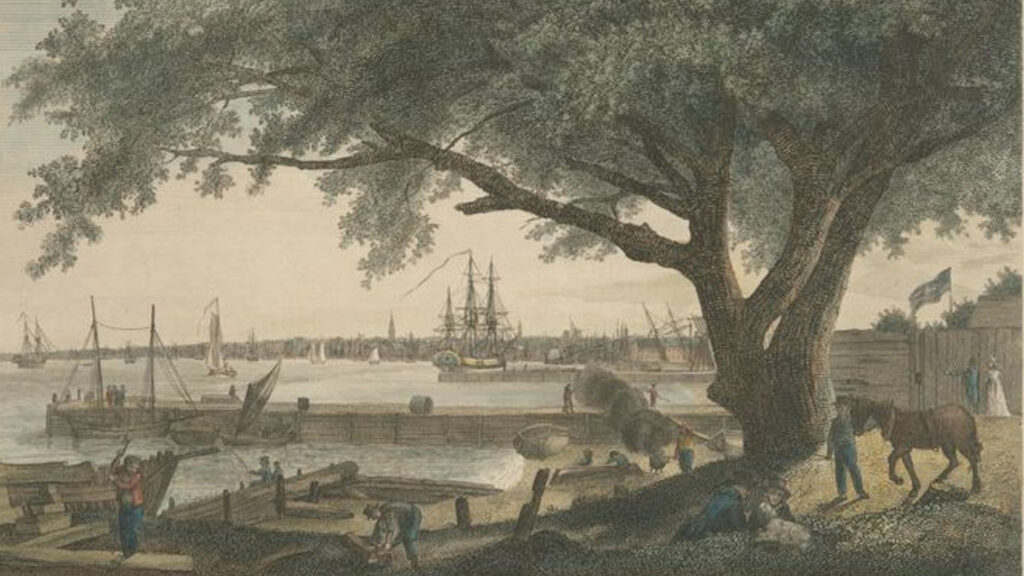
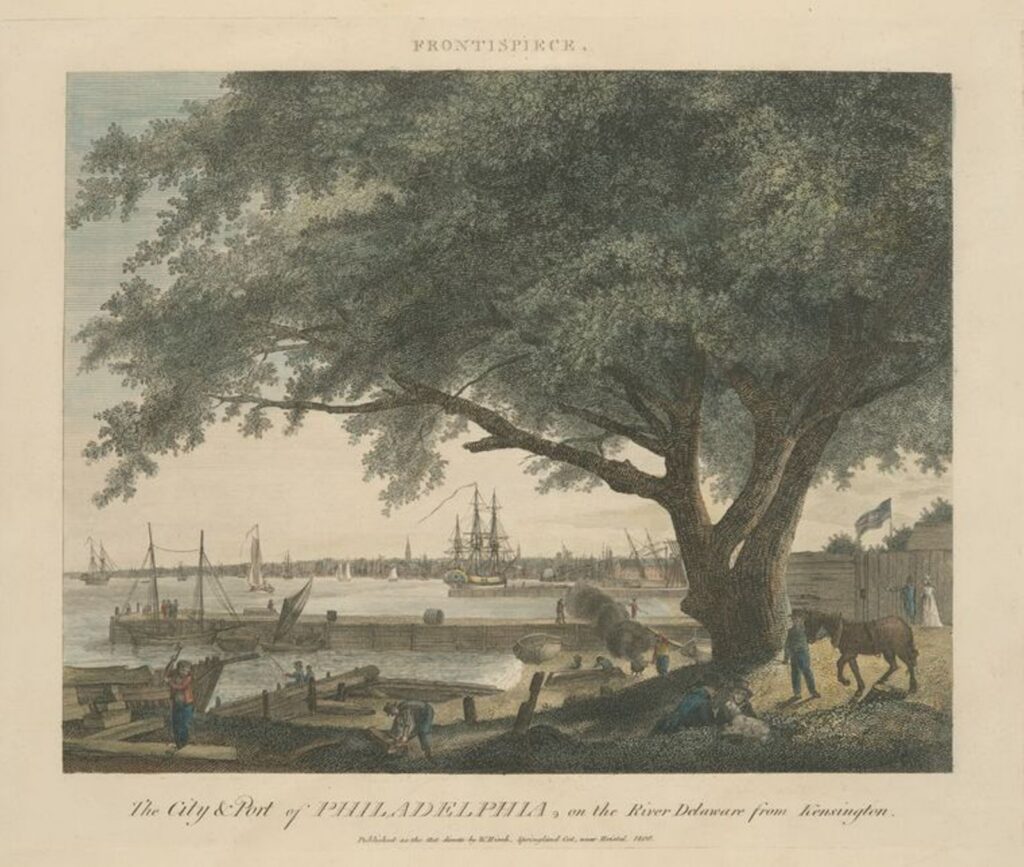
In the years following the American Revolution, Philadelphia remained a major importer of coffee in the young United States. However, the British were not going to make it easy for the former British colonies to flourish as a trading partner.
After a few years of disruption in trade, Philadelphia merchants eventually found new coffee trading partners in the Caribbean. During the 1780s, much of the imported coffee was coming from the French colony of Saint Domingue, what is now Haiti, which was then the most productive coffee-growing island in the Caribbean.
But Philly’s coffee trade changed again after the enslaved overtook the island of Saint Domingue during the Haitian Revolution of the early 1790s. Ultimately, the United States declined to trade with Toussaint L’Ouverture’s revolutionary government in Haiti, afraid of his influence on other enslaved communities that rose up throughout the Americas. And the formerly enslaved in Haiti had no desire to go back to large scale coffee production.
Many of the overthrown white planters fleeing the Haitian Revolution sailed to Philadelphia, bringing as many of their enslaved servants as possible. Existing trade networks linked white planters in Haiti to the port of Philadelphia. While the formerly enslaved were technically free upon arrival in Philadelphia, many signed indenture agreements which kept them tied to the white planter families.
Despite the revolution in Haiti, imported coffee trade grew exponentially in the United States. Before the war in 1776, the 13 British colonies imported just about 2 million pounds of coffee a year. By 1800, 30 years later, the new United States was importing 40 million pounds of coffee a year.
And a third of all coffee imports came in through the port of Philadelphia.
Coffee and Slavery in Brazil (1830s)
While the United States turned away from the Black government in Haiti, they assisted the spread of slavery and coffee production in Brazil.
During the 1830s and 40s, Brazil emerged as a major coffee exporter, supplying up to a third of the world’s coffee supply. The former Portuguese colony, became the independent Empire of Brazil in 1822 and aggressively expanded its coffee agriculture, adopting the plantation system that was made possible by enslaved African labor. Brazil became the world’s largest coffee exporter and remains so to this day.
The United States became the main importer of Brazilian coffee during a time when American coffee imports were skyrocketing, from 40 million pounds of coffee a year in 1800, to 158 million pounds of coffee a year in 1842. At this point, Philadelphia had competition on the coffee market from New York, Baltimore, and New Orleans. By the 1830s, the United States’ population had grown into one of the largest coffee consumers in the world.
Enslaved Africans in Brazil were forced to grow more coffee, and Americans drank more Brazilian coffee.
The increase in coffee imports was aided by the United States dropping tariffs on foreign coffee in 1832, hoping to increase access to coffee as an antidote to the hard drinking American public’s reliance on alcohol. The average price of coffee dropped, making coffee more popular with all classes.
Historians have documented how coffee agriculture in Brazil was aided and abetted by American politicians and coffee merchants. Southern leaders from the United States saw slavery as critical to the agricultural economy of both Brazil and the American south. Supporters of Brazilian slavery include John Calhoun, senator, Secretary of State, Vice President, and enslaver from South Carolina. Because of U.S. support for its coffee grown by enslaved labor, Brazil would not end slavery until 1888.
Resources
Bezanson, Anne, et al. “Beverages.” Prices and Inflation During the American Revolution, Pennsylvania, 1770-1790. University of Pennsylvania Press, 1951, pp. 222–42. JSTOR, http://www.jstor.org/stable/j.ctv4v3334.16. Accessed 16 Oct. 2026.
Foner, Eric. Tom Paine and Revolutionary America. 1976
Rosswurm, Steven. Arms, Country, and Class. 1987
The cook’s and confectioner’s dictionary: or, the accomplish’d housewife’s companion. Revised and recommended by John Nott. London: C. Rivington, 1723.
Garver, L.N. “Tea and Ethnicity in Southeastern Pennsylvania: A Transatlantic Perspective on German American Consumption.” Historical Archeology, 49, 30–53 (2015).
Hopkins, Tonya. “The Most Famous Soup You’ve Never Heard Of.” The Philadelphia Citizen. September 4, 2019. https://thephiladelphiacitizen.org/pepper-pot-soup-history/. Accessed 25 October 2026.
Jamieson, Ross W. “The Essence of Commodification: Caffeine Dependencies in the Early Modern World.” Journal of Social History, vol. 35, no. 2, 2001, pp. 269–94. JSTOR, http://www.jstor.org/stable/3790189. Accessed 21 Oct. 2026.
Keiko, Ota. “Coffee as a Global Beverage before 1700.” Journal of International Economic Studies, 32, March 2018, pp 43-55.
McDonald, Michelle Craig. “The Chance of the Moment: Coffee and the New West Indies Commodities Trade.” The William and Mary Quarterly, vol. 62, no. 3, 2005, pp. 441–72. JSTOR, https://doi.org/10.2307/3491531. Accessed 22 Oct. 2026.
McDonald, Michelle Craig. “Coffeehouses.” Encyclopedia of Greater Philadelphia Website. 2016. https://philadelphiaencyclopedia.org/essays/coffeehouses/. Accessed October 21, 2026.
Nash, Gary. “Reverberations of Haiti in the American North: Black Saint Dominguans in Philadelphia.” Pennsylvania History: A Journal of Mid-Atlantic Studies, vol. 65, 1998, pp. 44–73.
Rosswurm, Steve, et al. “Equality and Justice: Documents from Philadelphia’s Popular Revolution, 1775–1780.” Pennsylvania History: A Journal of Mid-Atlantic Studies, vol. 52, no. 4, 1985, pp. 254–68. JSTOR, http://www.jstor.org/stable/27773073. Accessed 16 Oct. 2026.
Saba, Roberto American Mirror The United States and Brazil in the Age of Emancipation. Princeton University Press, 2021.
Scribner, Vaughn. “Coffeehouse Coteries: Civil Dreams of Exclusivity and Consumer Power.” Inn Civility: Urban Taverns and Early American Civil Society, vol. 8, NYU Press, 2019, pp. 21–41. JSTOR, http://www.jstor.org/stable/j.ctv12fw94s.5. Accessed 21 Oct. 2026.
Smith, Barbara Clark. “Food Rioters and the American Revolution.” The William and Mary Quarterly, vol. 51, no. 1, 1994, pp. 3–38. JSTOR, https://doi.org/10.2307/2947003. Accessed 16 Oct. 2026.
Taplin, Theresa Altieri. “Pepper Pot Stew.” The Encyclopedia of Greater Philadelphia. 2020. https://philadelphiaencyclopedia.org/essays/philadelphia-pepper-pot/. Accessed 25 October 2026.
Topik, Steven, and Michelle Craig McDonald. “Why Americans Drink Coffee: Boston Tea Party or Brazilian Slavery?” Coffee : A Comprehensive Guide to the Bean, the Beverage, and the Industry. Ed. Robert W. Thurston, et al. Rowman & Littlefield, 2013.
Ukers, William H. All About Coffee. The Tea and Coffee Trade Journal Company. 1922.